> For the complete documentation index, see [llms.txt](https://docs.ticket-log.com/llms.txt). Markdown versions of documentation pages are available by appending `.md` to page URLs; this page is available as [Markdown](https://docs.ticket-log.com/documentation/administrators-guide/notification-settings.md).
# Notification settings
TicketLog will send email notifications to all users who are 'watching' a ticket, when any of the following changes occur on that ticket:
* A comment is added (either in TicketLog or Azure DevOps)
* State has changed
* Title has changed
* *Title change notifications only occur if notification contents is enabled (see below)*
## Notification options
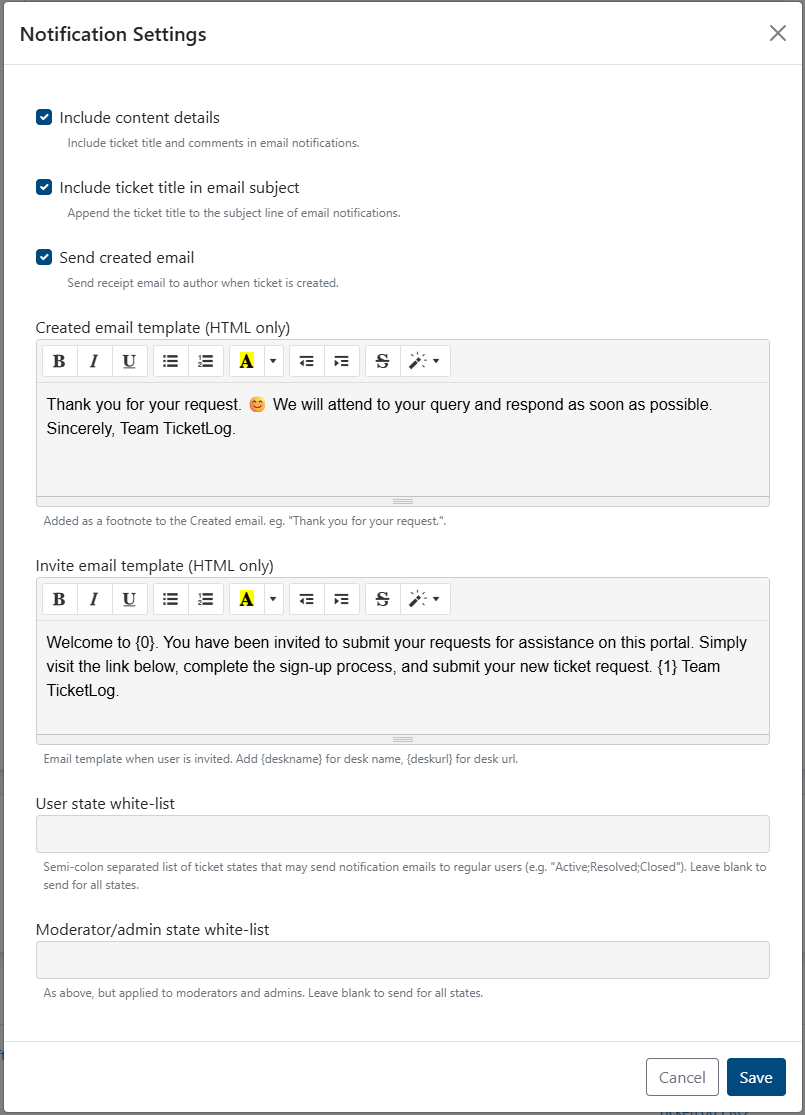
To edit notification options, visit the Customization settings page, and click Notification Settings.
The following settings are available:
### Include content details
TicketLog can include contents of new tickets or comments in email notifications.
By default, this option is disabled.
### Include ticket title in email subject
When this option is disabled, the subject of email notifications will refer only to the ticket number:
```
Service ticket #330 has been updated
```
When enabled, the title of the ticket will be added to the subject:
```
Service ticket #330 has been updated - Demo of new service ticket
```
By default, this option is disabled.
### Send created email and Created email template
TicketLog can optionally send an email notification when a new ticket is created. This is useful as a courtesy response and includes a link to the ticket in TicketLog.
Use the 'Created email template' panel to customize the message sent in the email.
By default, this option is disabled.
### Invite email template
TicketLog can include a customized message to invitation emails.
Use curly-brace notation ( {} ) to insert pre-determined parameters:
* **{deskname}** - insert the name of the desk
* **{deskurl}** - insert the direct url for the service
By default, this option is disabled.
### Notification filter by status
Administrators can now configure notifications to be filtered by state. If a ticket update occurs when that ticket is not in a specified state, a notification will not be sent.
By default, no filter is applied and all notifications are sent.
A separate filter can be specified for regular users and for Admin/Moderators.